
Discover the seven most common power quality monitoring mistakes industries make and learn how advanced monitoring solutions improve efficiency, reliability, and energy savings.
Introduction
Power quality is one of the most critical yet often overlooked aspects of industrial electrical systems. Poor power quality can lead to unexpected equipment failures, production downtime, increased maintenance costs, and higher energy bills. Issues such as voltage fluctuations, harmonic distortion, phase imbalance, and poor power factor may seem minor initially, but over time they can significantly impact operational efficiency and the lifespan of electrical equipment.
Many industries invest in energy monitoring systems but still struggle to identify the root causes of electrical problems due to inaccurate measurements, limited monitoring capabilities, or incomplete power quality analysis. Without reliable data, maintenance teams are forced to troubleshoot problems reactively rather than proactively.
This article explores seven common mistakes industries make when monitoring power quality and provides practical solutions to help improve system reliability, optimize energy performance, and support better operational decisions. Whether you manage a manufacturing plant, commercial facility, or industrial distribution network, understanding these mistakes can help you build a more efficient and resilient electrical infrastructure.
Did You Know?
More than 70% of power quality issues originate within industrial facilities themselves, often caused by non-linear loads, Variable Frequency Drives (VFDs), switching operations, and inadequate monitoring systems. Identifying these issues early can significantly reduce downtime and maintenance costs.
1. Using Low-Accuracy Energy Meters
Many industries still rely on Class 1.0 or Class 2.0 energy meters for critical energy monitoring. While suitable for basic measurements, these meters may introduce cumulative errors in large industrial installations.
Why it matters
- Incorrect energy audits
- Billing discrepancies
- Poor load analysis
- Inaccurate cost allocation
AIWAA Solution
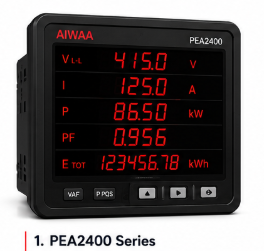
The PEA2400 Series provides:
- Utility-grade 0.2% accuracy
- kWh, kVAh and kVARh monitoring
- Three-phase status indication
- Panel-mounted industrial design
2. Monitoring Only Total Harmonic Distortion (THD)
Many conventional meters only measure THD or harmonics up to the 15th or 25th order.
Modern industrial facilities using VFDs, UPS systems and switching power supplies often generate much higher-order harmonics.
Why it matters
Higher-order harmonics can lead to:
- Transformer overheating
- Capacitor failures
- Nuisance breaker tripping
- Reduced equipment lifespan
AIWAA Solution
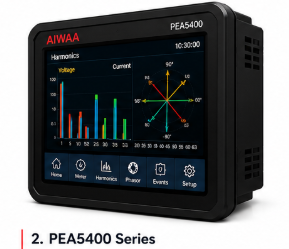
The PEA5400 Series measures:
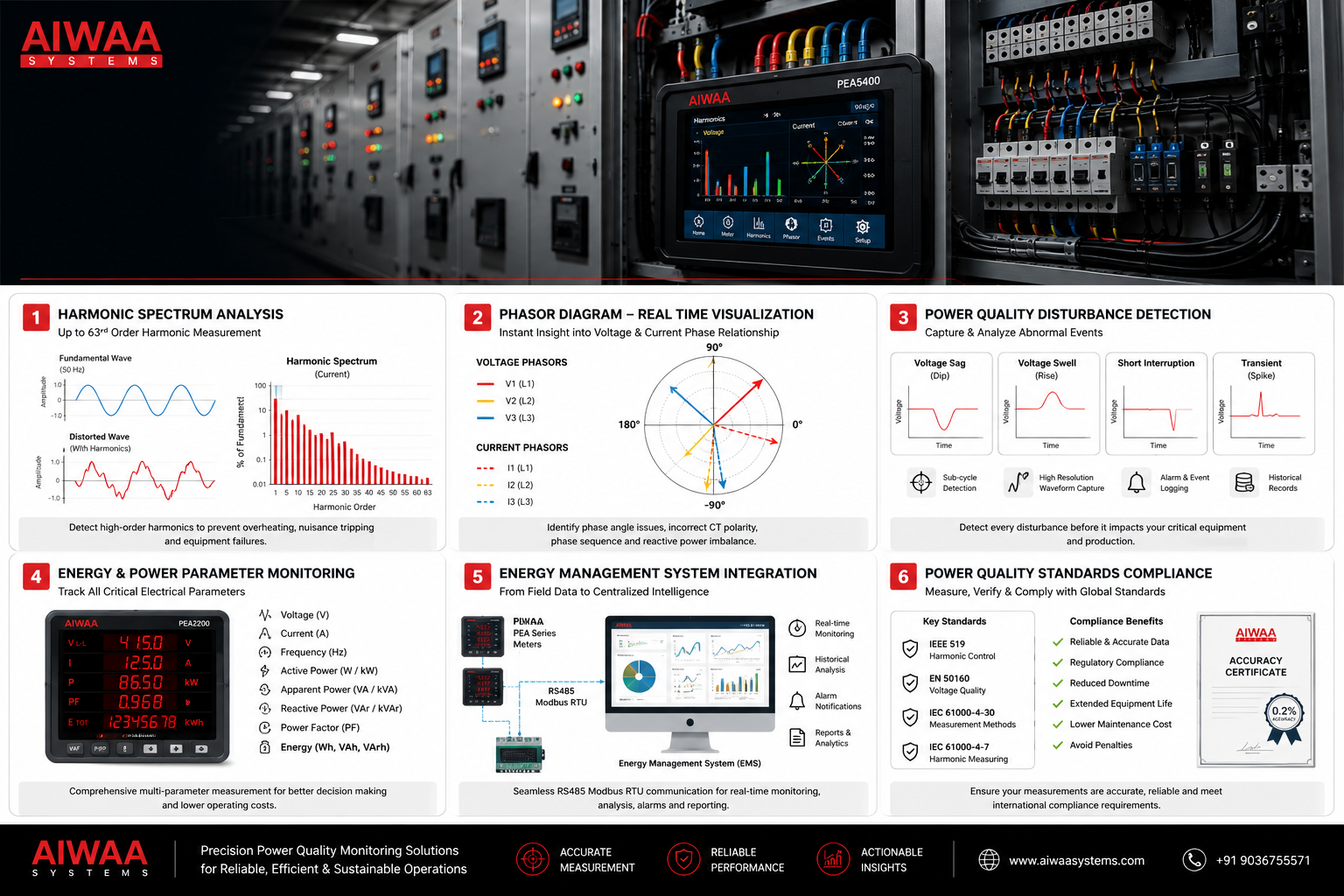
- Harmonics up to the 63rd order
- Individual voltage harmonics
- Individual current harmonics
- Real-time phasor diagrams
3. Assuming the Utility is Always Responsible
Studies indicate that many power quality disturbances originate inside industrial facilities rather than from the utility.
Common internal sources include:
- Variable Frequency Drives
- Welders
- UPS systems
- Large motors
- Capacitor banks
Proper monitoring helps identify the real source before unnecessary maintenance costs are incurred.
4. Ignoring Phase Relationships
Viewing only numerical values makes troubleshooting difficult.
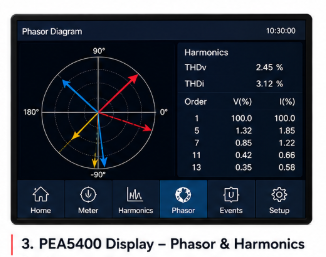
Phasor diagrams help engineers quickly identify:
- CT polarity errors
- Incorrect phase sequence
- Phase angle problems
- Reactive power imbalance
The PEA5400 Series provides real-time phasor visualization for faster diagnostics.
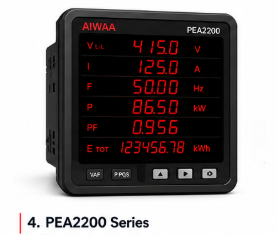
5. Tracking Only kWh
Many facilities focus only on energy consumption.
However, important parameters such as:
- Power Factor
- Apparent Power
- Reactive Power
- Frequency
- Current imbalance
also influence system efficiency and utility penalties.
The PEA2200 Series continuously monitors these parameters using a high-visibility LED display.
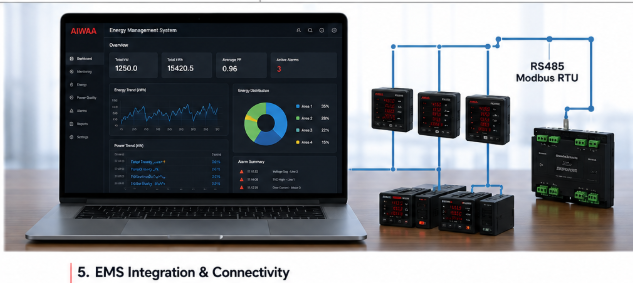
6. Not Integrating with an Energy Management System
Standalone meters provide local information but limited operational insight.
By integrating monitoring devices with an EMS, industries can:
- View live energy data
- Analyze historical trends
- Receive alarm notifications
- Optimize production efficiency
AIWAA multifunction meters support RS485 Modbus RTU for seamless integration.
7. Ignoring International Standards
Power quality measurements should always be evaluated against recognized standards such as:
- IEEE 519
- IEC 61000-4-30
- EN 50160
Monitoring against these standards helps validate system performance, identify compliance issues, and support maintenance decisions.
Conclusion
Power quality monitoring is more than collecting electrical data—it provides the insights needed to improve reliability, reduce energy waste, and protect critical equipment.
By choosing accurate instruments, monitoring the right parameters, and integrating data into a centralized Energy Management System, industries can make informed decisions that improve operational efficiency and reduce long-term costs.
Whether you're upgrading an existing monitoring system or planning a new installation, selecting the right solution is the first step toward better energy management.